Bernard Schlink, The Reader, 1995
..............................British International School of Budapest
..............................English 12SL
..............................January and February 2014
I. This class
We are studying The Reader for Part 3 of the Language and Literature Course: Texts and Contexts.You will be assessed on this novel for the Paper 2 exam,
as well as using it for a Written Task and Further Oral Activity.
Here is an extremely good guide to understanding the exam and triumphing over it.
II. The text
 Here is the novel in English translation:
as an .doc,
and as a .pdf.
I stress that we are studying The Reader as a novel in translation, as prescribed by the I.B. syllabus.
But I have to say I have my doubts about the English - or rather pseudo-American - of Carol Brown Janeway.
I would never, for instance, render
Mein Junghen heisst Michael, ist win Student
as
My kid's called Michael, he's in college
(p. 34 in English, p. 35 in German).
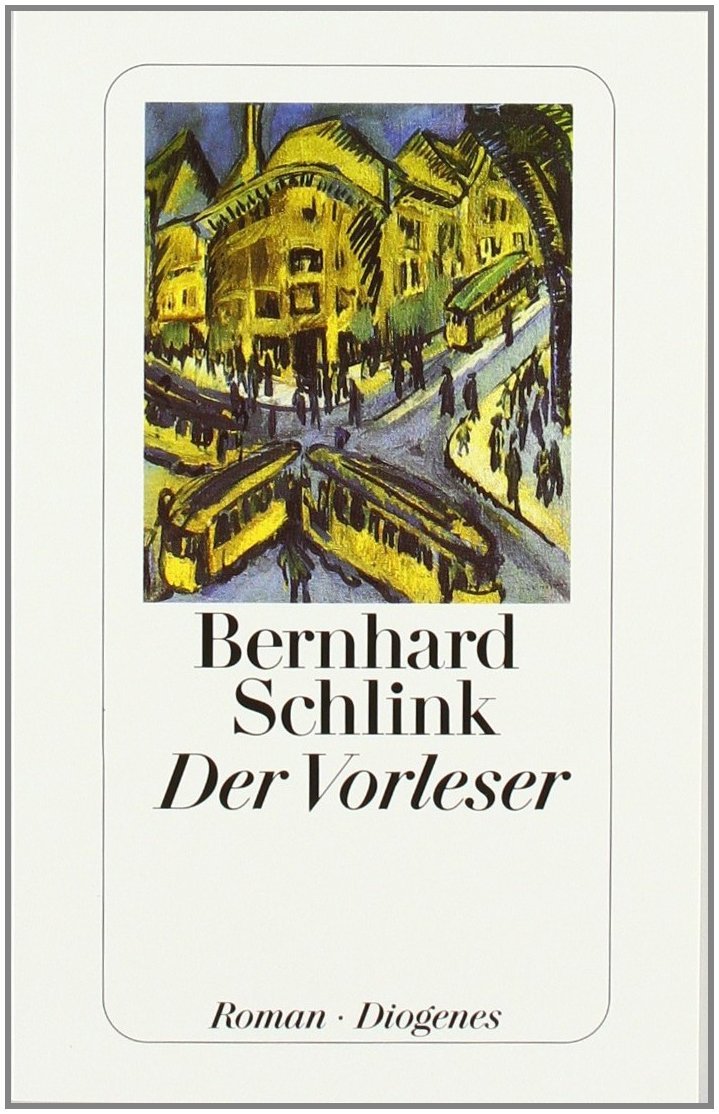
For those of you who can read German, the original novel, Der Vorleser, is online, should you ever want to compare.
(Note the extremely tame cover! Contrast it with the cover of the post-film English translation!)
I strongly recommend you copy the .doc English text from into a file and keep annotating it in red.
III. Resources
Here is an excellent study pack on this course. Do treasure this, and read through it carefully. (JL)Three PowerPoints:
on the context of the novel (JL)
on the experience of reading The Reader (JL) on Schlink's style
Two essays on The Reader, one good and one feeble (Which is which? Why?):
'Vergangenheitsbewaeltigung'
'Creating Distance'
Some more essay questions and answers. Make sure you can tackle all the lines of questioning here.
Here is a template for summarising the novel jun note form.
If you complete this - it will take less than an hour - you will be able to dazzle the examiners by citing and quoting.
IV. The author
 Bernhard Schlink is not a novelist but a lawyer. He studied law at Heidelberg and at the Free University of Berlin, and ended up as a judge and a professor before retiring in 2006.
Meanwhile he had made a name for himself with high-brow detective fiction.
In 1995 he published Der Vorleser (The Reader), which became a phenomenon. It was a bestseller in Germany, and was translated into 39 languages; it was the first German book to reach the number one position in the New York Times bestseller list; it won the Hans Fallada Prize, the Prix Laure Bataillon for works translated into French, and the Welt-Literaturpreis of the newspaper Die Welt.
Since then he's published more novels and a non-fiction book, Guilt about the Past.
Here is a radio interview about the latter book; and here's a print interview in which he meditates on how difficult it is being German - or if you like, how easy it is being Schlink explaining how hard it is to be German.
V. The question of collective guilt
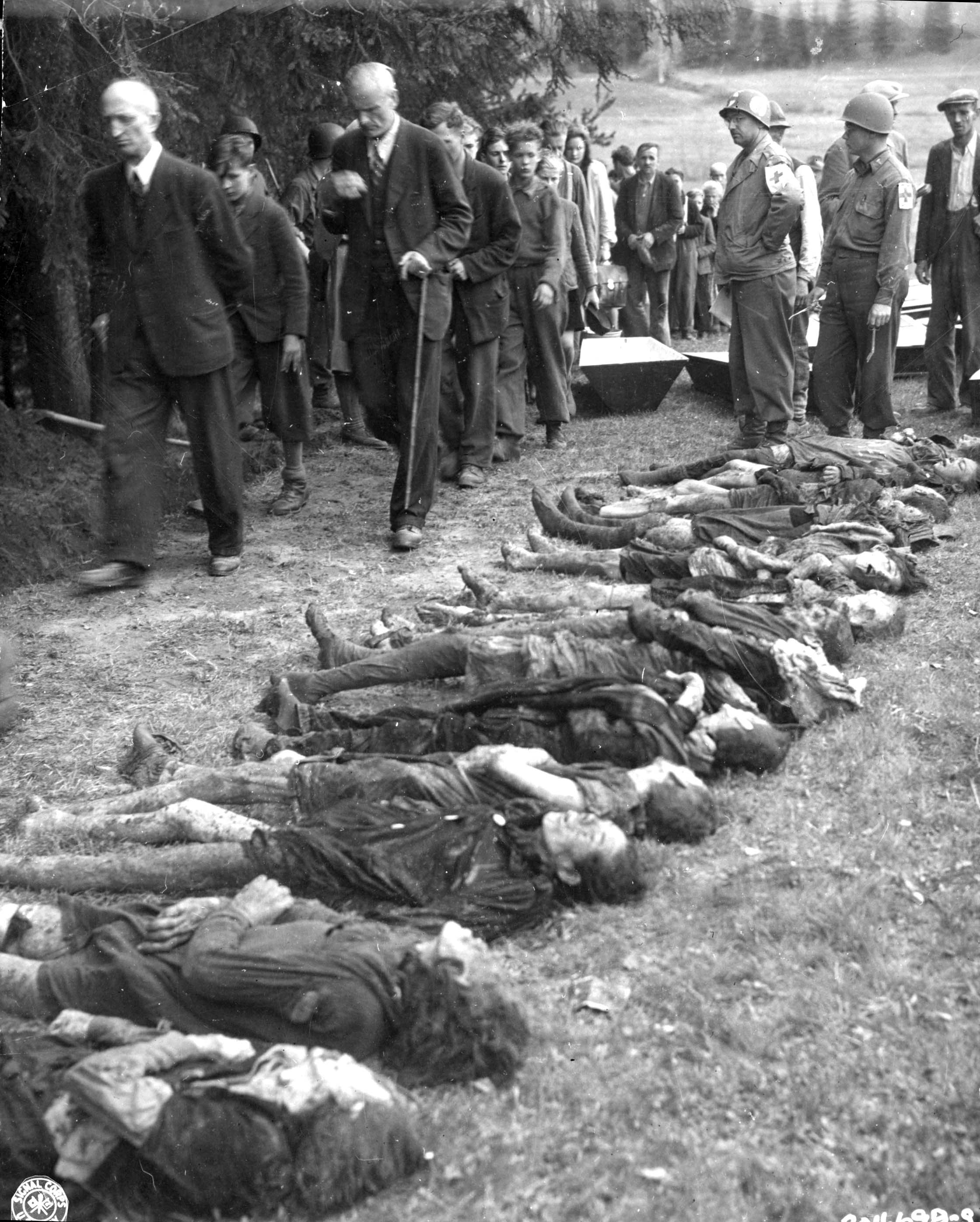
This photograph was taken in Volary in the Sudetenland on 11th May, 1945, just after the surrender of Germany.
German civilians are being forced by American soldiers to walk past the bodies of thirty women, Jewish by race, starved to death by S.S. troops on their 300-mile march across Bohemia.
The bodies have just been exhumed from their shallow graves, exhibited, then later placed in coffins and reburied in the cemetery.
Schlink was ten months old at the time.
The young Germans in this photograph seem aghast or fascinated. Their elders are carefully oblivious, and perhaps stricken with remorse.
In any case, next year these people will be expelled from their homes when the Czechoslovaks deported all Germans from the Sudetenland, under the principle of collective guilt.
One question is, what do we think of their fate?
Another question is how much we should care, given the fate of these thirty women.
VI. The film
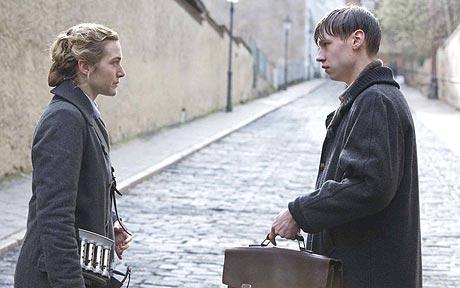 The Reader (2008) is a film adaptation directed by Stephen Daldry
from a screenplay by the great English playwright David Hare.
The Reader (2008) is a film adaptation directed by Stephen Daldry
from a screenplay by the great English playwright David Hare.
Kate Winslet plays Hanna, Ralph Twistleton-Wykeham-Fiennes the older Michael, and David Kross (born 1990) as the young Michael, although not quite so young as in the book. She swept the board for awards that year as best actress; there were lots of Academy Award nominations too.
In this video David Pollard, who is subservient, interviews Daldry, who is not uncreepy, and Kross, who is not unbland.
Most people liked the soundtrack, which you can listen to while you work here if you want to get hardcore.
Here's the official trailer, and here, for the moment, the film itself, with excellent visual quality but dubbed into Thai; here is it in English, but with bad picture quality. Combine the two if you can.
It's a competent film, but it's still a Hollywood affair, that is to say a soothing entertainment, designed to go down with popcorn. Hanna is played by the most luminous and beautiful actress of her generation; Michael is played, as a child by a pretty and cheerful-looking eighteen year-old man, and as middle-aged wretch by a charming, sane-looking aristocrat.
The picture's biggest problem is that it simply doesn't capture the chilling intensity of its source material," which is to say, the novel we are studying, says Patrick Goldstein of The Los Angeles Times. Well, that is one of its problems. You might also think it has all the artistic and moral flaws of the book and then some. It has
Here is a rather good parody of the film.
VII. Is this a great novel?
Suzanne Ruta too: This offbeat novel, by a German writer born in 1944, about a high school kid in love with a woman formerly employed at Auschwitz, leaps national boundaries and speaks straight to the heart. Spare and direct, it follows a pair of star-crossed lovers across the decades . . . .
…..Literature is not only a bridge between the generations, sometimes it may get closer to the truth of recent history than benumbed eyewitness accounts. But this redemptive magic has its limits. Substituting great books for human contact is a cowardly dodge. At the novel's somber conclusion, Michael betrays Hanna yet again.
…..Carol Brown Janeway's translation reads well, although Hanna keeps calling Michael ''kid,'' adding a jarring note of Bacall-Bogart insouciance. The hero's jejune temperament also leaches into the language, which seems flat at times. And the abrupt ending isn't wholly convincing. But Schlink's daring fusion of 19th-century post-romantic, post-fairy-tale models with the awful history of the 20th century makes for a moving, suggestive and ultimately hopeful work, an original contribution to the impossible genre with the questionable name of Vergangenheitsbewaltigung, ''coming to terms with the past.''
The Reader is both a literary surprise and a moral challenge: a riveting, provocative, and deeply moving novel about a young boy's erotic awakening in a passionate, clandestine love affair with an older woman, and what happens to them both when the secrets in her past are revealed. The woman he had loved so passionately is a criminal. Much about her behaviour during the trial makes no sense. But then, suddenly and terribly, it does - Hanna is not only obliged to answer for a horrible crime, she is also desperately concealing an even deeper secret. As the past erupts into the present - both Michael's past with Hanna, and the past of Germany itself - Michael must accept that he will never be free of either of them.
Hailed for its coiled eroticism and the moral claims it makes upon the reader, this mesmerizing novel is a story of love and secrets, horror and compassion, unfolding against the haunted landscape of postwar Germany . . . and so forth.
Even Oprah Winfrey says yes: A parable of German guilt and atonement and a love story of stunning power, The Reader is also a work of literature that is unforgettable in its psychological complexity, its moral nuances and its stylistic restraint.
VIII. But is this novel wicked?
Here is a rather good article by in the soft-Left English Guardian by Nicholas Wroe, weighing up hostile criticism and praise.
The case for the prosecution (as argued by Ron Rosenbaum in Slate) is this:
So much is made of the deep, deep exculpatory shame of illiteracy -- despite the fact that burning 300 people to death doesn't require reading skills - that some worshipful accounts of the novel (by those who buy into its ludicrous premise, perhaps because it's been declared "classic" and "profound") actually seem to affirm that illiteracy is something more to be ashamed of than participating in mass murder... Lack of reading skills is more disgraceful than listening in bovine silence to the screams of 300 people as they are burned to death behind the locked doors of a church you're guarding to prevent them from escaping the flames. Which is what Hanna did, although, of course, it's not shown in the film.
Schlink himself says (in this 2008 interview): I never had the idea, 'OK, educate people properly and give them good education, and give them good culture and they will be good people.' That was never on my mind. For me, Hanna's illiteracy just stands for the many ways one gets into something without actually planning to, without saying 'OK, I want to become a Nazi, I want to become a concentration camp guard.' One lets oneself be drawn into it, that's how things often happen. In her case it's her illiteracy that makes her give up this position. She would have had to unveil her illiteracy and find a position as a camp guard where she hopes and succeeds in hiding her illiteracy some more. There is something like a moral illiteracy that most of us learn and have in our mind and heart. And I think there are people who are just moral illiterates.
IX. Is this novel indecent?
The most prominent critic of The Reader damns it, not just as wicked, but as 'aromatic porno-pomposity'; the Wikipedia article raises the charge of ‘cultural pornography'. Do you agree?
Let's consider the tricky topic of pornography.
One obvious response to the ghastliness of the Nazi regime was to jeer at it. Here, for instance, is Hitler's famous globe dance in Charlie Chaplin's The Great Dictator (1940).
Now consider the staggering 'Springtime for Germany' Broadway number from Mel Brooks' The Producers (1967). What do we make of the gorgeous creatures in S.S. uniform and fishnet stockings who appear at 1'28"? The two Broadway producers in Brooks' comedy are deliberately aiming at tastelessness: they want their show to flop, so that they can defraud their investors. Everyone realises there's nothing glamorous about massacres (reflect on the photo in section V); therefore everyone will understand that these S.S. sex-kittens are preposterous.
But that was back in 1967. In the course of the 1970s there was a coarsening in our civilisation's sexual taste. It became possible - partly because the war was more distant, partly because pornography was becoming mainstream - to find the black-clad cruelties of the Nazis a turn-on. The result was some revolting art-house sado-masochism, including The Night Porter (1974), discussed by Frederic Raphael - a film which is utterly, utterly without any sense of humour.
By the time there was another film made of The Producers, by Susan Stroman in 2005, chorus-girl Stormtroopers were no longer merely a delirious satire: they were erotically serious. Consider the creatures dancing round the edge of this webpage. What exactly is their tone?
Which brings us to the equally humourless Reader and to Hanna. The question is: does the novel, while posing as a literate, sombre and dour study in guilt and redemption, really cash in on the titillation of Nazism? Is the gorgeous, illiterate, somehow innocent Hanna so different from these gorgeous, illiterate, somehow innocent dancers?
Have a look at this magnificent hatchet-job on The Reader, 'Bad Beyond Imagination', by the Anglo-American novelist Frederic Raphael. His case is that Schlink not only writes kitsch (noting the banality of his vocabulary, the sugar of his eroticism and the blandness of his brevities), but 'aromatic porno-pomposity' of a sort all too common in decadent art or pseudo-art about the Third Reich:
Let us have no nonsense here . . . . For a longish period after the war, the charm of the S.S. went unrealised and unexploited. The sadistic appeal of the camps and the kit, cruelty and murder as merchandise, the voyeuristic erotics of barbarism: these things escaped the sadly straight survivors of the war as they sat on their 1940s utility furniture . . . [But] the alert salaciousness of the modern mind will have no difficulty seeing why . . . photographs of naked female concentration camp inmates parading past leering, jack-booted, enviably tailored guards . . . [makes for] a profitable industry. [The] confection of politically-engaged "art" [chimes] with the swastika'ed wardrobe that could be seen in Paris, during the 1960s, on the caches-sexe of the sugar-titted chorenes at the Crazy Horse Saloon in the Avenue Georges V.
(Raphael, you observe, does not have a banal vocabulary himself!)
Raphael has created a cottage industry of attacking the book (and film), which obviously irritates as well as scandalising him:
The success of The Reader has proved literally inexorable: it could not be prayed away, fervently though a coterie composed of those with a certain sense of smell wished it consigned to oblivion, if never to the bonfire. To burn such books is to put them in better company than they deserve; but to go along with their many admirers is to subscribe to the virtues of vulgarity and . . . smirking fame.
Aren't they a sweet couple? So well-bathed.
What a lovely relationship she has with water. Shame about the fire thing.
X. Class schedule
M….. 13 January….. 1345-1440….. IBH4…..The Holocaust and fiction; Schlink; Daldry's 2008 film
T…... 14 January….. 1440-1535….. IBH4…..I,iv*. The repentance of Oedipus. Close analysis of I,i and I,iii.
You need to finish the reading at home quickly:
the expectation is that you'll have read to the end of the chapter marked *.
we'll be discussing mainly context, and doing close analysis of key chapters.
W….. 15 January….. 1100-1155….. C6….. ..I,xvii*. Illiteracy. The affair (not, as it happens, illegal).
…………………………………………'Inter-textuality'.
……………………………………………"Your whole life in one night": I,xvi,p.78: Warlock (1959) 1h48'48"
……………………………………………Close analysis of I,xi and I,xvi.
M….. 20 January….. 1345-1440….. IBH4…..II, xvii.*
……………………………………………Close analysis of I,xvii and II,i.
……………………………………………Nausicaa, Odysseus and the Odyssey.
……………………………………………"Confidence in bourgeois culture" (III,v). Self-indulgence?
……………………………………………Is Schlink right to make such an issue of imagining the Holocaust?
…………………………………………..……(After all, we can't imagine even a simple murder!)
……………………………………………Schlink as a vengeful, law-hating judge!
……………………………………………Child abuse and broken, obsessive personality.
T…... 21 January….. 1440-1535….. IBH4…..III,xii*
……………………………………………Close analysis of II,xiv,xv,xvii.
W….. 22 January….. 1100-1155….. C6….. ... Re-read section IV below, about the 2008 Reader by Stephen Daldry;
……………………………………………then carefully watch the first 54 minutes of the film.
……………………………………………What are big differences between book and film?
……………………………………………Do you agree that Hanna, as played by the luminous Winslet,
……………………………………………is an essentially sympathetic character? Should she be?
……………………………………………Be ready to discuss your reaction to the film.
……………………………………………
………………………Make sure you have entirely finished reading the novel
……………………………and completed your summaries,
………………………………..by Monday.
M….. 27 January….. 1345-1440….. IBH4….. Watch the second part of the film (54'-91).
……………………………………………Then as a group have a look at the sample essays
……………………………………………I have given you on The Reader.
……………………………………………Don't panic if they seem too hard; by the time you finish
……………………………………………you will have no difficulty tackling questions of this standard.
……………………………………………As a group, read the first three questions and answer aloud,
……………………………………………and then discuss them. Do you agree with the critic?
T…... 28 January….. 1440-1535….. IBH4….. Watch the third part of the film (91'-124').
……………………………………………Discuss: is Hanna redeemed in the film?
……………………………………………Does her death seem like a sort of martyrdom?
……………………………………………Is she martyred by her illiteracy? By her literacy?
……………………………I have given you two short responses to The Reader.
……………………………Would Eden, Nora and Katja consider 'Vergangenheitsbewaeltigung',
……………………………Naomi and Alaistair 'Creating Distance'.
……………………………Summarise what the essay says, decide if you agree and why,
……………………………and be ready to present your findings to the group tomorrow.
W….. 29 January….. 1100-1155 …….. 'Vergangenheitsbewaeltigung' and 'Creating Distance'.
……………………………What are we to do with the memory of Nazi atrocity?
……………………………One way is Schlink's intense (humourless? self-centred?) brooding.
……………………………Another way is to jeer and laugh at the satanic absurdity of it all:
……………………………here is the notorious 'Springtime for Hitler' dance number from The Producers (1968),
……………………………with a chorus-line of gorgeous S.S.ettes -
……………..…………………just like Hanna?
……………………………The historical context: 1944-45, the midwinter of European civilisation.
……………………………Note-taking.
……………………………………………
M….. 3 February….. 1345-1440….. IBH4…..Schlink's style: coldness and distance.
……………………………Are Michael and Hanna simply unloveable freaks?
……………………………Close analysis of III,i; III, ii; III, viii.
T…... 4 February….. 1440-1535….. IBH4…..The structure of the novel
W….. 5 February….. 1100-1155….. C6…..Does Michael betray Hanna?
…CCCCCCCCCCCCCCCCCCCCCCIs Hanna the victim of injustice?
…CCCCCCCCCCCCCCCCCCCCCCWhat is moral illiteracy?
M….. 10 Febuary….. 1345-1440….. IBH4…..Is this novel timeless?
…CCCCCCCCCCCCCCCCCCCCCCClose analysis of the last two chapters.
…CCCCCCCCCCCCCCCCCCCCCCThe beauty of the law in The Reader.
….CCCCCCCCCCCCCCC.Michael, Hanna and the Odyssey: the hopelessness of homecoming.
T…... 11 February….. 1440-1535….. IBH4…..1. Raphael speaks caustically of 'the charm of the S.S.'?
…CCCCCCCCCCCCCCCCCCCCCCDoes this novel exploit the titillation of evil?
….CCCCCCCCCCCCCCC.2. Prepare an answer to one essay questions on Gatsby and The Reader
….CCCCCCCCCCCCCCC.(page 4 of the handout on exam preparation).
W….. 12 February….. 1100-1155….. C6…..The issue of indecency.
T…CCCCCCCCCCCCCCCCCCCCCCMake sure you read the Raphael article on The Reader and the sheet on Schlick's style.
M….. 17 Febuary….. 1345-1440….. IBH4…..
T…... 18 February….. 1440-1535….. IBH4…..
W….. 19 February….. 1100-1155….. C6…..
XI. Leave a comment
Widget is loading comments...
XII. Email me
Click on a 1958 German stamp to dispatch your message: ………………